

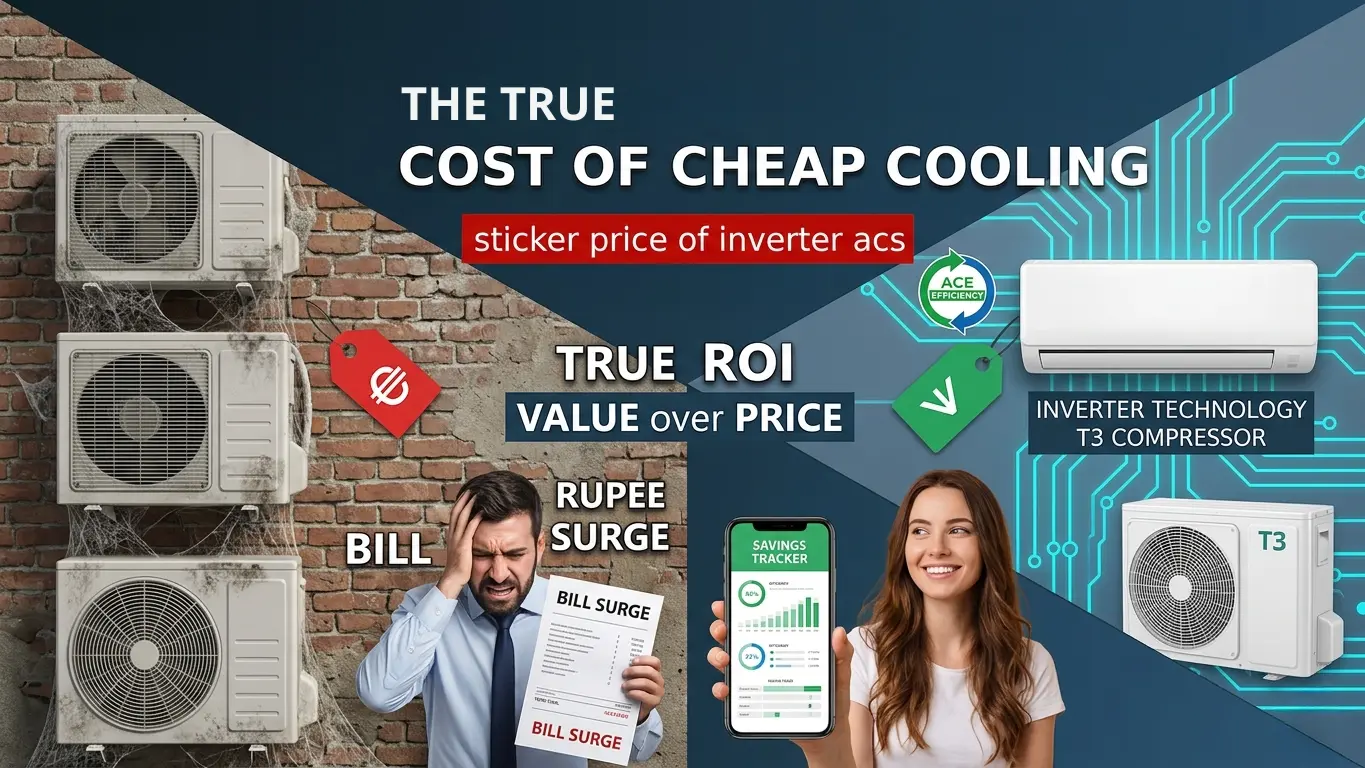
The True Cost of Cheap Cooling: Why Smart Homeowners Look Beyond the Sticker Price of Inverter ACs
Summer temperatures are hitting record-breaking levels, turning our homes into literal ovens. When the mercury crosses 45 Celcius, flicking on the Air Conditioner isn’t a choice, it’s a survival mechanism.
Every retail storefront out there claims their Inverter AC can slash your electricity bills by 60 C to 70 C. Yet, thousands of buyers end up disappointed when their meter continues to spin at terrifying speeds.
Why? Because they bought a price tag, not an engineering solution. Let’s break down the hidden math of smart summer cooling and how you can maximize your actual monthly savings.
1. The Myth of the “Cheap” Inverter
Many buyers settle for lower-tier brands or unauthorized grey-market units simply because they save a few thousand upfront. What they don’t realize is that cheap units often skimp on crucial hardware, such as using undersized condensers or low-grade compressors that constantly trip.
An efficient system relies heavily on T3 Compressor Technology. Standard compressors begin to lose their cooling efficiency or trip completely once ambient temperatures breach 43 C. A robust T3 compressor, however, is built to sustain optimal cooling loads even when outdoor temperatures hit extreme 50 C conditions.
If your compressor trips frequently due to extreme heat, it draws a massive spike in starting current every time it tries to restart—completely wiping out any potential “inverter savings.
2. The Direct Relationship: Room Volume vs. Compressor Stress
One of the most common mistakes consumers make is purchasing a mismatched unit for their space. Installing a 1-Ton AC in a large living room under the assumption that “it will just take a bit longer to cool” completely destroys the core function of inverter technology.Inverter technology works by dynamically slowing down the compressor motor once the room reaches its target temperature. If the AC is undersized, the room never hits that target thermal equilibrium. The compressor is forced to run at maximum capacity (100% power draw) indefinitely, costing you more than a traditional non-inverter unit would.
The Essential Sizing Matrix
Before you buy, map out your room size correctly:
- Up to 120 sq. ft.: 1.0 Ton Inverter AC
- 120 to 200 sq. ft.: 1.5 Ton Inverter AC
- 200 to 300 sq. ft.: 2.0 Ton Inverter AC
3. The Behavior Variable: How You Drive Your AC Matters
n inverter AC is like a hybrid vehicle; your driving habits dictate your fuel average.
Setting your AC to $18^\circ\text{C}$ on a scorching summer afternoon tells the system to work at maximum strain. The real efficiency sweet spot lies around 26 C paired with Eco-Mode.
Engineering data shows that for every single degree you raise your thermostat setting, you instantly save approximately 6% in power consumption. Additionally, inverter units show their true value during extended operational cycles (4+ consecutive hours), making them perfect for bedrooms and dedicated office workspaces
Why Smart Buyers Partner with Bit Electronics
Buying an air conditioner isn’t just a simple transaction; it’s a long-term infrastructure investment for your home. At Bit Electronics, we bridge the gap between technical complexity and real-world value.
- 100% Genuine, Authorized Inventory: Every unit comes backed strictly by direct official brand warranties.
- Engineered for Local Conditions: We explicitly stock premium models featuring advanced T3 compressors and optimized energy-star ratings tailored to survive brutal summer heatwaves.
- Transparent Pricing: No hidden installation fees or unvetted upcharges, just honest market rates combined with expert consulting.
Don’t let inefficient hardware inflate your utility costs this summer. Stop by our store or connect with our tech consultants to discover the ideal cooling solution optimized for your space, architecture, and budget.
Contact Bit Electronics today for a free expert appliance consultation!


Leave a Reply